
The Cyrillo-Methodian Research Centre at the Bulgarian Academy of Sciences (CMRC–BAS) is an academic research unit within the field of Cultural and Historical Heritage and National Identity.
The mission of the Centre is to identify, investigate, and promote the phenomena of the Cyrillo-Methodian tradition as one of the foundations of Bulgarian and European cultural identity, in the full diversity of the contexts in which this tradition developed. Its research scope encompasses Old Bulgarian literature and language, medieval history and archaeology, art history, cultural anthropology, information technologies, and the history of the humanities. Through empirical research and discourse analysis, the Centre seeks to produce valid and reliable results in a research field heavily shaped by mythologizing narratives concerning the lives and work of Cyril and Methodius, their disciples, and the earliest period of Bulgarian literary culture.
Another major focus of the CMRC’s mission is the development of contemporary research tools in Cyrillo-Methodian studies and their provision in a structured and accessible form for the benefit of society. This work contributes to establishing the Cyrillo-Methodian tradition as an integral component of Bulgarian cultural heritage.
The Cyrillo-Methodian Research Centre (CMRC) is the only research institution in Bulgaria and abroad entirely dedicated to the comprehensive study of the work and legacy of the Slavic Apostles, Cyril and Methodius, and their disciples. The Centre collaborates with a broad network of Bulgarian and international scholars and institutions and publishes their research contributions in the journal Palaeobulgarica and the series Cyrillo-Methodian Studies.
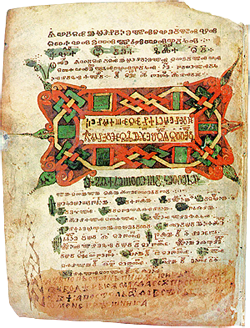
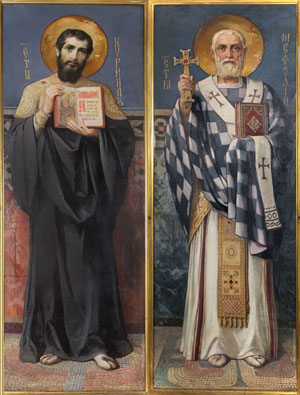
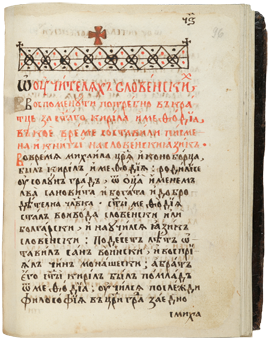
The Cyrillo-Methodian Research Centre (CMRC) was established on 1 March 1980 by Order No. 7 of 11 February 1980 of the Bureau of the Council of Ministers as a research organisation within the Bulgarian Academy of Sciences (BAS), with legal personality and state budget funding, headquartered in Sofia. Its mandate comprised research, public outreach and dissemination activities in Bulgaria and abroad, as well as the coordination of scholarly research related to the work and legacy of Cyril and Methodius.
The CMRC is the institutional successor to the Kliment Commission of the Bulgarian Academy of Sciences, established in 1913, which marked the first institutionalisation of Cyrillo-Methodian studies in Bulgaria, and to the Commission for the Publication of Sources on the Life and Work of Cyril and Methodius, established in 1934. Members of both commissions included the founders of Bulgarian Palaeoslavic studies: Aleksandar Teodorov-Balan, Yordan Ivanov, Benyo Tsonev, Vasil Zlatarski, Stoyan Argirov, Mihail Popruzhenko, and Yurdan Trifonov.
The second commission also brought together prominent scholars from across the European Slavic studies community. Its members included the Czech scholars Miloš Weingart, Josef Vajs, František Dvorník, and Josef Kurz; the Slovenian historian Milko Kos; the Russian Slavist Valery Aleksandrovich Pogorelov; the Ukrainian scholars Hilarion Sventsitsky and Ivan Ohienko; the Polish linguist Stanisław Słoński; and the Croatian linguist Stjepan Ivšić. The commission’s successful work in collecting and publishing sources on the life and work of the Slavic Apostles was interrupted by the bombing of Sofia in 1943. Its institutional development was subsequently further impeded by the Soviet academician Georgy Derzhavin, who was sent to reorganise the Bulgarian Academy of Sciences along Soviet lines. He opposed the proposal of the Academy’s Historical and Philological Branch to establish dedicated institutes for Cyrillo-Methodian studies and Slavic studies. As a result, these fields were largely marginalised within the research paradigm of the Bulgarian humanities.
Despite this profound disruption, as well as the persecution of prominent scholars such as Veselin Beshevliev, Ivan Duychev, Petar Dinekov, and many others, Cyrillo-Methodian studies survived as a scholarly field. A major event that brought the work and legacy of Cyril and Methodius back into focus was the international commemoration of the 1100th anniversary of the creation of the Slavic script, included in the UNESCO calendar for 1963. On this occasion, the Cyrillo-Methodian Commission was re-established, chaired by Kiril Mirchev and comprising Ivan Lekov, Ivan Galabov, Petar Dinekov, Emil Georgiev, Bonyu Angelov, Dimitar Angelov, and Ivan Duychev.
In 1970, the Commission was institutionally re-established as a structure under the Presidium of the Bulgarian Academy of Sciences, with Corresponding Member Kiril Mirchev as its chair and two research associates. Attempts to transform the Commission into an administrative and propaganda unit were ultimately unsuccessful, largely due to the efforts of Academician Petar Dinekov. He developed a scholarly programme for a research centre based on the Cyrillo-Methodian Commission, which became a reality with the decision of the Council of Ministers to establish the Cyrillo-Methodian Research Centre. The new structure within the Presidium of the BAS was headed by Academician Dinekov.
During the Centre’s first years, work continued on the Cyrillo-Methodian bibliography, initiated by the preceding Cyrillo-Methodian Commission. The two scholars who joined the CMRC from the Commission were supplemented by a specialist bibliographer and two philologists responsible for studying Slavic as well as Latin, Greek, and Romance-Germanic sources. The Centre’s staff was gradually expanded in order to achieve an optimal interdisciplinary composition covering the diverse research fields encompassed by Cyrillo-Methodian studies.
In 1983, the Centre organised its first two international conferences, and in 1984 the first volume of the series Cyrillo-Methodian Studies was published. In 1991, the journal Palaeobulgarica was registered as an official publication of the CMRC, having previously been associated with the Centre for Bulgarian Studies. Since then, the journal has developed into a respected scholarly forum for research in Cyrillo-Methodian and Old Bulgarian studies. It is indexed in Scopus, Web of Science, and ERIH PLUS, as well as in seven additional bibliographic and abstracting databases.
The restructuring of the Bulgarian Academy of Sciences in 1994 enabled the Centre to broaden its research paradigm through the incorporation of the group responsible for the publication of Old Bulgarian monuments from the Institute for Bulgarian Language. Intensive research was subsequently undertaken on the Old Bulgarian translation of the Old Testament, while research in hymnography was expanded and significant studies of Cyrillo-Methodian sources were undertaken.
Researchers at the Centre also began developing digital descriptions of medieval texts in collaboration with computational linguists from Italy. This work was followed by the digitisation of the CMRC’s scholarly archive and of manuscripts held in the Scientific Archive of the Bulgarian Academy of Sciences, collected during the expeditions of the Kliment Commission and the Cyrillo-Methodian Commission. These activities laid the foundations for the KIRILOMETODIKON. An important part of the Centre’s work has also focused on the study and description of Bulgarian manuscripts preserved in foreign repositories, with digital copies incorporated into the repository.
The CMRC’s successful research activity received the highest evaluation in the 2009 international assessment of the Bulgarian Academy of Sciences, conducted by the European Science Foundation and ALLEA. In 2017, the Centre was ranked third among humanities research institutions in Bulgaria in the report of the Standing Expert Commission of the Bulgarian Ministry of Education and Science for monitoring, evaluation, and analysis of research activity.
As an internationally recognised research institution, the CMRC participates in numerous research and educational projects with partners in Bulgaria and abroad. In recent years, particular emphasis has been placed on the implementation of research infrastructure projects, including CLaDA-BG, the Centre of Excellence Heritage BG, and the National Scientific Programme KINNPOR.
Learn more about the history of the CMRC: